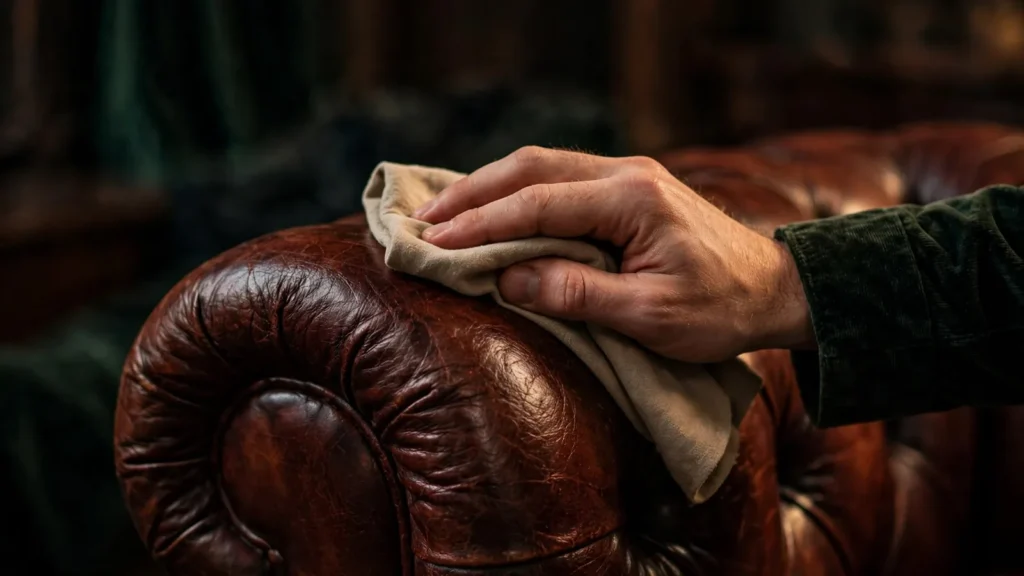
A Chesterfield is not a sofa you replace. The deep buttoning, the rolled arms level with the back, the low, studded base — it was designed to outlast fashion, and plenty of them outlast their first owners. But the leather only keeps its looks if it’s looked after, and leather care is mostly about what you don’t do to it.
Know which leather you have
Not all leather asks for the same care, and a Chesterfield can wear any of these:
- Full-grain aniline is the leather left closest to natural: no surface coating, a soft, waxy feel, and it marks, absorbs spills and develops a patina. Beautiful, and the most thirsty.
- Semi-aniline has a light protective finish — still natural-looking, a little more forgiving.
- Protected (pigmented) leather carries a coloured coating: more uniform, harder-wearing, the easiest to live with, and the least in need of feeding.
A quick test: put a drop of water on a hidden patch. On aniline it darkens and soaks in; on protected leather it sits on the surface. Condition an aniline as if it were skin, a protected leather more gently and less often — and never use a product meant for one on the other without checking the label.
The routine that keeps it alive
- Dust weekly with a dry, soft cloth. Dust is abrasive: left in place, it grinds into the finish every time someone sits down.
- Clean out the buttoning. The folds around deep buttons collect dust and crumbs where a cloth can’t reach. A soft brush — an artist’s brush or a clean, dry paintbrush — lifts it out without stressing the leather around the buttons.
- Keep it out of the sun. Direct sunlight through glass will fade one arm and one end of the back while the rest stays rich, and the heat dries the leather as it fades it. Move the sofa, sheer the window, or rotate the room around — but don’t leave a Chesterfield baking.
- Mind the air conditioning. Constant dry, cold air from a vent aimed at the sofa dries leather out just as surely as sun.
- Condition every six to twelve months with a conditioner made for your leather type, worked in sparingly and buffed off. Leather that is fed stays supple; leather that dries starts to crack along the creases, and cracks can’t be conditioned away.
- Blot spills at once with a clean cloth — never soak, never scrub, and never reach for heat to dry it.
What never to use
Baby wipes, silicone sprays, furniture polish, washing-up liquid and all-purpose cleaners all damage leather finishes — some strip the coating, some leave a silicone film that later repairs can’t stick to. Saddle soap belongs on saddles, not on an aniline Chesterfield. If a product doesn’t say it’s for upholstery leather, it doesn’t go on the sofa.
Leather doesn’t wear out so much as dry out. Feed it, shade it, and a Chesterfield looks better at thirty years than most sofas look at three.
When it’s a workshop job, not a home job
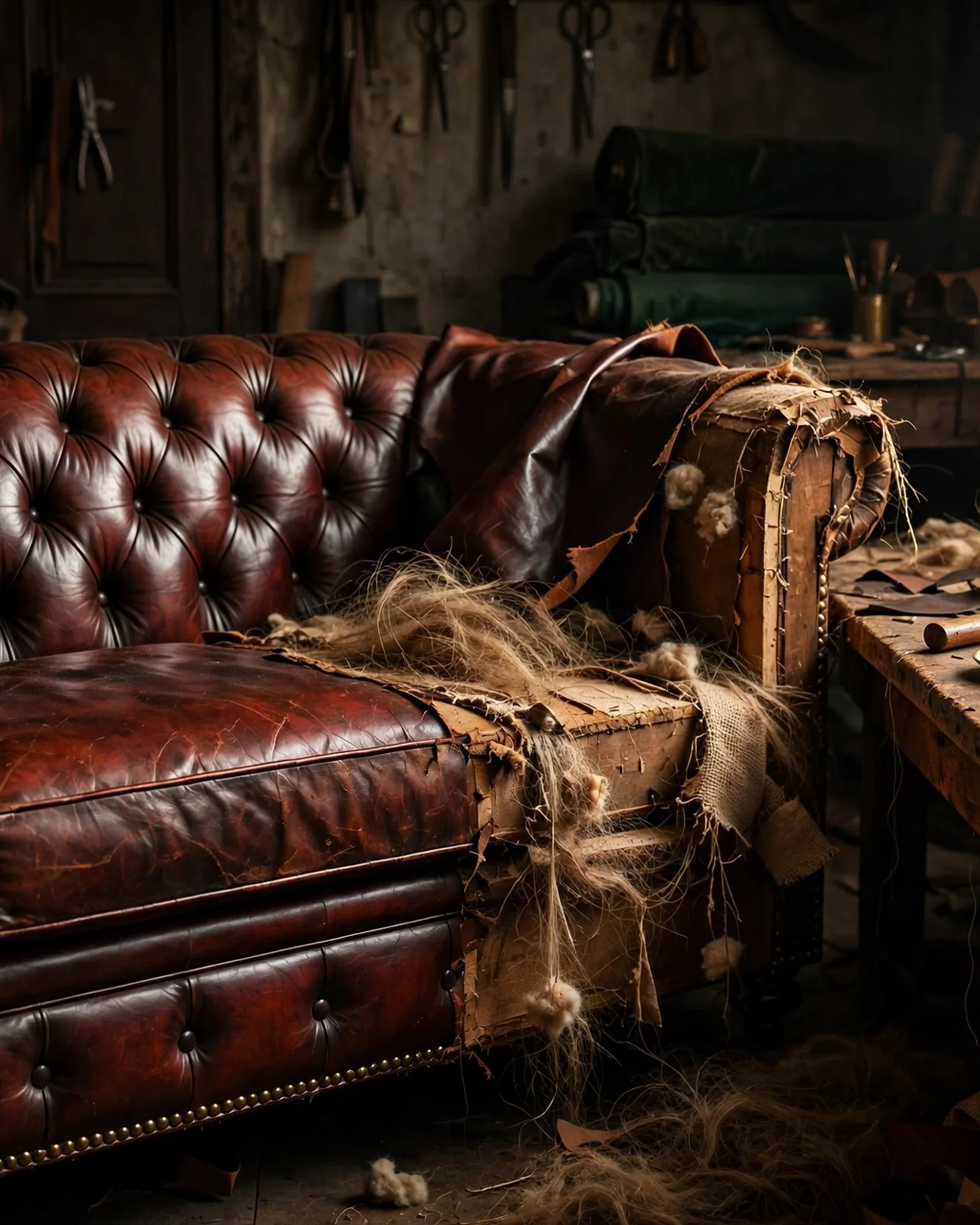
Some things no amount of home care will fix: leather cracked through or peeling, colour worn away on the arms and seat edges, a button torn or sunk into the stuffing, a seat that has sagged because the springs or webbing beneath the fixed, buttoned upholstery have failed. Those are antique and chesterfield restoration jobs — the upholstery has to come apart in the right order and go back the same way — and they’re worth doing properly, because the piece underneath is worth it.
Yours looking tired?
Send three photos — the whole sofa, the worst wear, and a close-up of the leather — and we’ll tell you what care can save and what needs the workshop.
The bottom line
Dust it, brush out the buttoning, keep it out of the sun and feed it once or twice a year. That’s nearly all a Chesterfield asks — and in return it will hold its colour, its shine and its shape for decades.
Got a sofa like this?
Send three photos and we'll tell you honestly what it needs and what it costs.
Free photo quote